

Master in Sports Journalism online
Private degree issued by Universidad Europea de Madrid
Classes in English | Start: 26 oct. 2026 | Escuela Universitaria Real Madrid Universidad Europea | Faculty of Medicine, Health and Sports | 60 ECTS |
This online Master’s in Sports Journalism offers a practical, digitally focused approach to prepare you for a rapidly evolving industry. Designed for professionals shaping the future of sports communication, it lets you progress your career with flexibility. Learn 100% online from expert faculty and professionals, gaining skills to create impactful content and manage multi-platform communication strategies.
You will be trained to lead sports journalism by:
- Creating high-quality content across multiple formats.
- Analysing sports news with rigour and insight.
- Reporting professionally on live events using storytelling techniques.
- Managing digital platforms and communication strategies for media outlets, clubs, brands and more.
The programme combines online learning with an optional immersive week in Madrid, where you will gain hands-on experience covering press conferences and sporting events at the Bernabéu Stadium and Ciudad Real Madrid, and working in the university’s television and radio studios.
Discover our official Master's Degree in Spanish: Máster Universitario en Comunicación y Periodismo Deportivo
Practical methodology in television, radio and press

The best Training Ground in the world.

Santiago Bernabeu Stadium, a Football History Monument

Sound booth/Radio studio.

Professional TV set and production control for live broadcasts and audiovisual production.

Photograph and Digital Images Laboratory
Photography developing and digital processing laboratory.

Montage room Avid, Final Cut, Premiere, DaVinci and Protools.
The quality you deserve

National Sports Award
Escuela Universitaria Real Madrid Universidad Europea was honoured with the 2018 National Sports Award, “Copa Stadium”, in recognition of its contribution to education, research, and the professionalisation of sports both nationally and internationally.

Shangai Ranking
Our faculty is ranked among the top 30 worldwide in the prestigious Academic Ranking of World Universities by the Shanghai Ranking 2025.
International experiences in the sports industry
Join an international experience and explore the sports industry from the inside. Network with professionals, professors, and peers from diverse nationalities, expanding your global connections. These are just two of the more than 14 experiences from which you will be able to choose one.

Switzerland
Gain a global perspective on how major international sports governing bodies operate. Learn directly from international experts and visit institutions such as FIFA, FIBA, the Olympic Museum, and UEFA.

Madrid
Gain exclusive insights into the Real Madrid Club's operations with special access to the Ciudad Real Madrid Florentino Pérez facilities. Visit major international sports entities and meet with their executive leaders.

White Week
Experience a unique sports event featuring streamed talks from industry leaders, club executives, and elite athletes throughout the week.
Discover what your experience will be like

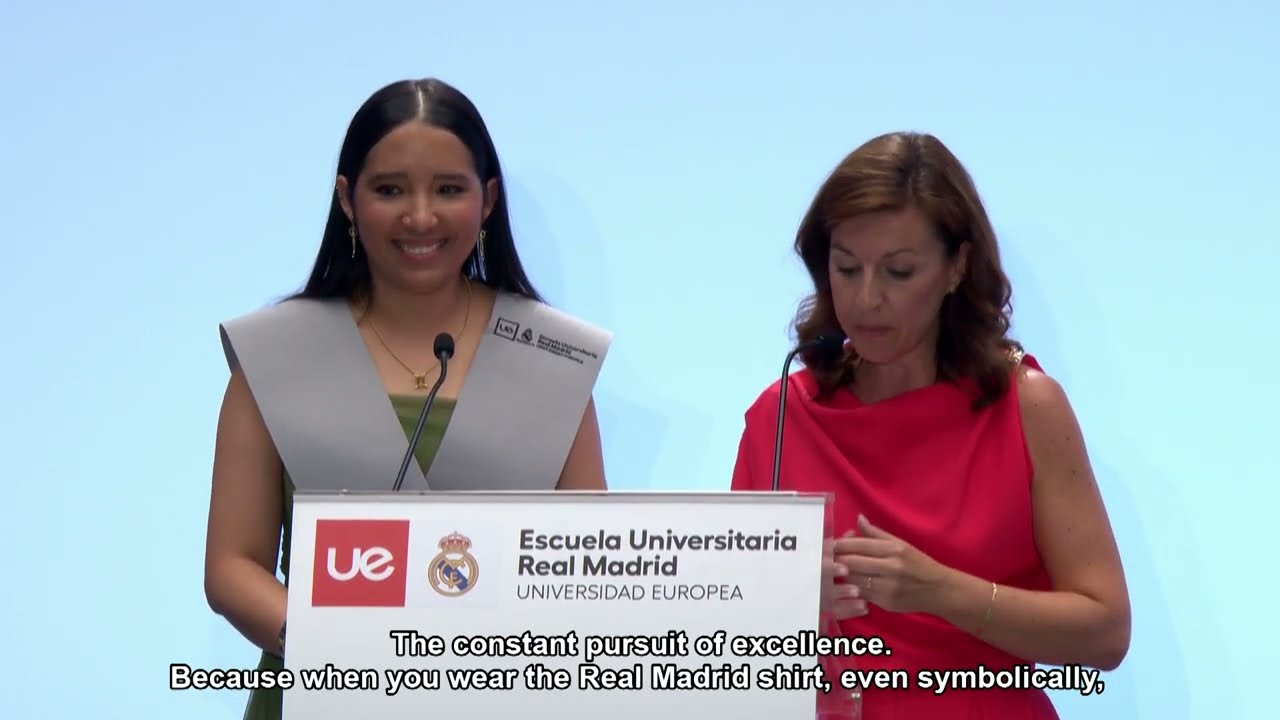

Horizon breakers: pushing boundaries, creating your future with AI
At Escuela Universitaria Real Madrid Universidad Europea, we’ll teach you how to apply artificial intelligence (AI) in real-world settings. We’re proud to be recognised by Forbes as one of the most influential universities in education for 2025, thanks to our strong commitment to generative AI.

You’ll have access to the Advanced Course in Study Techniques with AI, where you’ll learn step by step how to integrate artificial intelligence into your daily life as a student.
You’ll use tools to increase your productivity and optimise your learning process, enhancing your academic experience and improving your results.
You’ll also take part in an exclusive workshop with Google, where industry professionals will guide you through the implementation and use of various AI applications.
Throughout the master’s programme, you’ll have the opportunity to participate in the AISports initiative, attending workshops and learning from experts how to implement AI in sports management.
Discover how AI is transforming the sports sector through real-world case studies, showcase your abilities, and earn your AISports digital badge.
Customize your master and earn a double qualification

Postgraduate Diploma in Big Data and Artificial Intelligence in Sports Management
Specialize in artificial intelligence and big data to drive digital transformation in the sports industry. Learn how to apply advanced technologies to optimize processes, improve decision-making and unlock the value of data.

Postgraduate Diploma in Sports Marketing and Digital Transformation
Master the latest trends in sports marketing and digital innovation. Learn how to design impactful marketing strategies, enhance fan engagement and lead digital transformation across sports organizations.
Study plan
The curriculum is composed of ten modules that will provide you with practical, multidisciplinary and up-to-date training. At the end of the programme, the student will receive the Private Master's Degree in Digital Communication and Sports Journalism online, granted by Universidad Europea de Madrid.
Study plan structure
Module I. Sports Journalism Environment. 6 ECTS
- During this module, students will learn about the current sports journalism environment, as well as its evolution and methodologies.
- Social context: present and future of sports journalism. Recent history of Spanish sport and the international landscape.
- Economic and legal context: legal and economic foundations of sport.
Module II. Written Press. 6 ECTS
- During this module, students will acquire the fundamental skills required to produce reports and various written journalistic formats.
- Event coverage.
- Layout, design and content.
- Journalistic genres: match reports, features, interviews.
- Internet and integrated newsrooms.
- Structure and organisation of sports newspapers.
- Regional and special editions.
- Newsrooms across different media outlets.
Module III. Radio Sports I. 6 ECTS
- During this module, students will explore in depth the technical aspects of radio broadcasting and learn about its key components.
- History of radio.
- Radio technology environment.
- Multi-link programmes.
- Sports radio production.
Module IV. Radio Sports II. 6 ECTS
- During this module, students will learn how to create radio programmes and develop different types of content, including sports commentary and report writing.
- Sports commentary.
- Radio genres: features and interviews.
- Radio and advertising.
Module V. TV and Sports I. 6 ECTS
- During this module, students will learn about the different elements that make up television production, with a focus on recording techniques.
- Introduction to sports television.
- Audiences, finance and broadcasting rights in television.
- Journalistic activity: interviews, live broadcasts and presenting.
Module VI. TV and Sports II. 6 ECTS
- During this module, students will learn how to produce television content in various formats, as well as develop skills in presenting and live broadcasting.
- Television workflows.
- Coverage, production, recording, planning and programme development.
- Television commentary.
Module VII. Digital Journalism and Social Networks. 6 ECTS
- During this module, students will learn more about the technologies and tools used in media operations, along with the basics of blog creation, SEO and SEM.
- Sports blogs.
- Technology applied to sports journalism.
- Social media and trends.
- SEO positioning and Big Data.
- Strategic audience analysis.
- Digital marketing and personal branding.
- Analytics, evaluation and metrics.
Module VIII. Sports Communications Management. 6 ECTS
- During this module, students will learn and deepen their understanding of media management, internal communication within clubs and organisations, and event preparation.
- Internal communication.
- Sports protocol.
- Communication in times of crisis.
Module IX. Master’s Thesis. 6 ECTS
- During this module, students will complete a final Master’s project aimed at fostering teamwork and applying the knowledge acquired throughout the academic year.
- Research within the field of sports journalism.
Module X. Practical Cases. 6 ECTS
- During this module, students will analyse a range of real-world case studies from the professional field, with the aim of developing decision-making, critical analysis and teamwork skills.
An intensive one-year programme to specialise in sports sustainability
1
First Semester – Fundamentals of sports journalism and news narrative
Build a solid foundation in sports communication by understanding the media ecosystem, the structure of information and the keys to storytelling in sport. Develop skills to analyse current events, work with data and communicate accurately across formats.
- Understand how sports media operate and the principles of journalistic information.
- Analyse sports news with a professional approach, interpreting data, context and sources.
- Develop writing, narration and storytelling skills for text, video, audio and social media.
2
Second Semester – Advanced practice and digital strategy
Apply your knowledge in real scenarios, integrating digital tools, advanced narrative and communication strategies for media, clubs and sports brands. Complete the programme with a final project that reflects your profile as a sports journalist.
- Create multiplatform content for digital media, audiovisual channels and social environments.
- Manage audiences, platforms and digital strategies to position content and communicate with impact.
- Apply live coverage and storytelling techniques for press conferences and major sporting events.
Career opportunities with the online Master in Sports Journalism
Sports Journalist
Work across print, digital, radio, or television media, covering events, conducting interviews, and reporting on the sports industry.
Digital Communication Specialist
Develop and manage digital communication strategies and social media content for sports brands, organisations, and athletes.
Sports Presenter
Present or commentate on live sports events across television, radio, and digital platforms.
Content Editor
Create, edit, and curate specialised sports content for digital platforms, media outlets, and organisations.
Communications Manager
Lead communication strategies for clubs, federations, and sports entities, managing brand image and messaging.
Audiovisual Producer
Produce and manage audiovisual sports content, including programmes, documentaries, and digital formats.
Digital Strategy Consultant
Advise sports organisations on digital transformation, audience engagement, and content strategy across platforms.
Methodology
Flexibility: our online methodology allows you to adapt your studies to your needs.
Support: you will have the support of our expert professors who will facilitate your learning, as well as an accompanying tutor who will guide you and help you achieve your goals.
Experiential learning: learn by doing, without action there is no learning. Receive comprehensive training based on real-life cases combined with theoretical and practical learning.
Constant communication: with the latest technologies, you will be in direct contact with the university, your professors and your classmates.

Our educational model

Experiential Learning
The student learns by doing; there is no learning without action.

Meaningful learning
The teacher relates the knowledge, skills and previous experiences to the interests, expectations and cognitive characteristics of the students.

Collaborative learning
The students "learn together", so they are motivated not just by their own learning but to increase the achievements of others, forming a social and academic learning experience.

Professional learning
The teacher acts as an advisor and as a guide of the learning towards a professional application.

Constructive and discovery learning
Students investigate and explore concepts. This allows you to build cognitive structures by comparing, relating and reorganising new concepts with those you have already dealt with.

Autonomous learning
The teacher encourages the students to learn for themselves, developing self-learning. The student is understood as an active and cooperative agent, protagonist of their own education.

Individualised learning
The teacher is sensitive to the diversity and different learning styles of the students, adjusting the training activities to suit their needs.

Creative learning
The development of creativity and initiative allows knowledge to be perceived as open, unfinished, something which can always be redefined and understood from other points of view.
Admissions
Recommended profile
The Master in Sports Journalism is designed for journalists, communicators and related professionals who want to focus their careers on the sports industry, as well as active professionals seeking to expand their expertise in sports communication. This programme is ideal for those aiming to master digital platforms, storytelling techniques and strategic communication to thrive in a sector that is constantly evolving and highly competitive.
Admissions requirements
For access to the accredited international Private Master's Degree in Digital Communication and Sports Journalism online it is necessary to fulfil of the following requirements:
- To be in possession of a university degree. In the case of being a graduate from a university outside of Spain, it is not necessary to have had the degree officially recognised by the Spanish Education Ministry.
- To have accredited professional experience related to the programme of interest. This guarantees the achievement of the abilities specified in the profile for prospective students section. Some of the programmes offered at Universidad Europea do not allow access through professional experience. See the full list here.
- Higher vocational training graduates who can accredit professional experience after completion of the internship.
In all cases, the university may limit access to certain degrees if a specific university degree has not been previously completed.
Demonstrate having the right level of English according to the chosen course, which will be evaluated through a personal interview.
Admissions process
The admission process to pursue an online undergraduate or postgraduate certificate at Universidad Europea can be carried out throughout the year, although enrolment on any of our programmes is subject to availability. In order to complete the process, follow these simple steps:
1
Documentation
You will need to send the specific documentation to your personal advisor
- Admissions form.
- Legal document required for accessing the programme
- Photocopy of your ID.
- Curriculum vitae.
2
Admissions test
Once your documentation has been reviewed, your personal advisor will contact you.
- Competency assessment test.
- Personal interview.
- Language assessment test (B2).
3
Reserving a place
Formalising the reservation of a place through our different methods of payment
- Direct debit.
- Credit card.
- Online payment.
Scholarships and financial aid
We want to help you. If you want to study at Universidad Europea, you will have at your disposal a wide selection of own and official scholarships.
Excellence grants
We believe that talent and dedication should go further.
We support professionals who, like you, stand out for their academic, sporting or entrepreneurial achievements and are ready to advance their development within the sports industry.
Credit recognition and transfers
You don’t have to stick with something you don’t like. That’s why we’ve designed specific plans for credit recognition and transfers.
Request your online credit recognition review, transfer your academic file and start studying at Universidad Europea.


Meet the faculty


You have seen of 16 results
Frequently asked questions
How is the Master in Sports Journalism Real Madrid online connected to Real Madrid C.F.?
The Master is part of the Real Madrid Graduate School Universidad Europea. This means you study sports journalism using case studies, values and working methods linked to an elite club. You understand how a top sports brand communicates on and off the pitch. That connection is a strong differentiator in the sports journalism field.
What kind of student is the Master in Sports Journalism Real Madrid online designed for?
The online sports journalism master is aimed at graduates in journalism, communication, audiovisuals or similar areas who want to specialise in sport. It also fits professionals who already work in media or content and need a sports focus. You don’t need to be a technical expert, but you do need passion for sport and storytelling. Motivation is key to keep up with the pace of news.
Will I only study football in the Master in Sports Journalism Real Madrid online?
Football is very present in the Master in Sports Journalism Real Madrid online, but it is not the only focus. You also analyse basketball, Olympic sports and major international competitions. The idea is that you can work in different sports media, not just football channels. You learn to adapt your sports journalism style to each discipline and audience.
How are assessments done in the Master in Sports Journalism Real Madrid online?
In the online sports journalism master you are assessed through continuous work, projects and participation. You will create articles, video pieces, podcasts and social media content instead of only written exams. The evaluation focuses on how you apply sports journalism techniques in real formats. Feedback from lecturers helps you improve your work week by week.
What digital tools will I use during the Master in Sports Journalism Real Madrid online?
Throughout the programm you use tools for video editing, audio editing, online publishing and social media management. You also work inside the virtual campus to collaborate with classmates and lecturers. The goal is that you feel comfortable in a digital sports newsroom environment. These skills are essential for modern sports journalists.
Will I work with live broadcasting or only written sports content in this online master?
You practise different formats: live commentary simulations, stand-ups, interviews, opinion pieces and analysis. You don’t stay only in written content. The programme trains you to be versatile in front of the camera and behind the mic. This multi-format approach is very valuable for sports media.
Does the Master in Sports Journalism Real Madrid online have an international profile?
Yes, the online sports journalism master attracts students from different countries who share a passion for sport. You work on global competitions, international leagues and major events. This gives you a broader view of sports journalism beyond one local market. It’s a good option if you want to build a career with an international angle.