

World-leading Executive MBA in Sports Management online
Private degree issued by Universidad Europea de Madrid
Classes in English | Start: April 2026 | Escuela Universitaria Real Madrid Universidad Europea | Faculty of Medicine, Health and Sport |
This MBA in Sports Management online has been recognised as the best executive MBA in sports by the prestigious QS Ranking 2025, standing out for its impact in employability and international profile. Designed for ambitious professionals, it allows you to advance your career without giving up flexibility. With a 100% online methodology, you will learn from a world-class faculty and executives from Real Madrid C. F., gaining a comprehensive global view of sports management models and strategies.
You will be trained to lead the business side of sports by:
- Designing and implementing strategies for sports institutions.
- Managing marketing, finance, operations, and innovation within the industry.
- Identifying and developing new business opportunities.
- Leading teams and driving organisational change with measurable impact.
You can also join the Entrepreneurship and New Sports Business Creation Program, where you will transform ideas into real projects. In addition, the program includes two international experiences at leading sports institutions, guided by top industry experts and executives — a unique opportunity to expand your horizons and gain global expertise.
View the Spanish version of the master: Máster en Gestión Deportiva online
The quality you deserve

QS Ranking

Mundo Posgrado

FSO

Shanghai Ranking

National Sports Award
International experiences in the sports industry


London

Madrid

White Week
Discover what your experience will be like



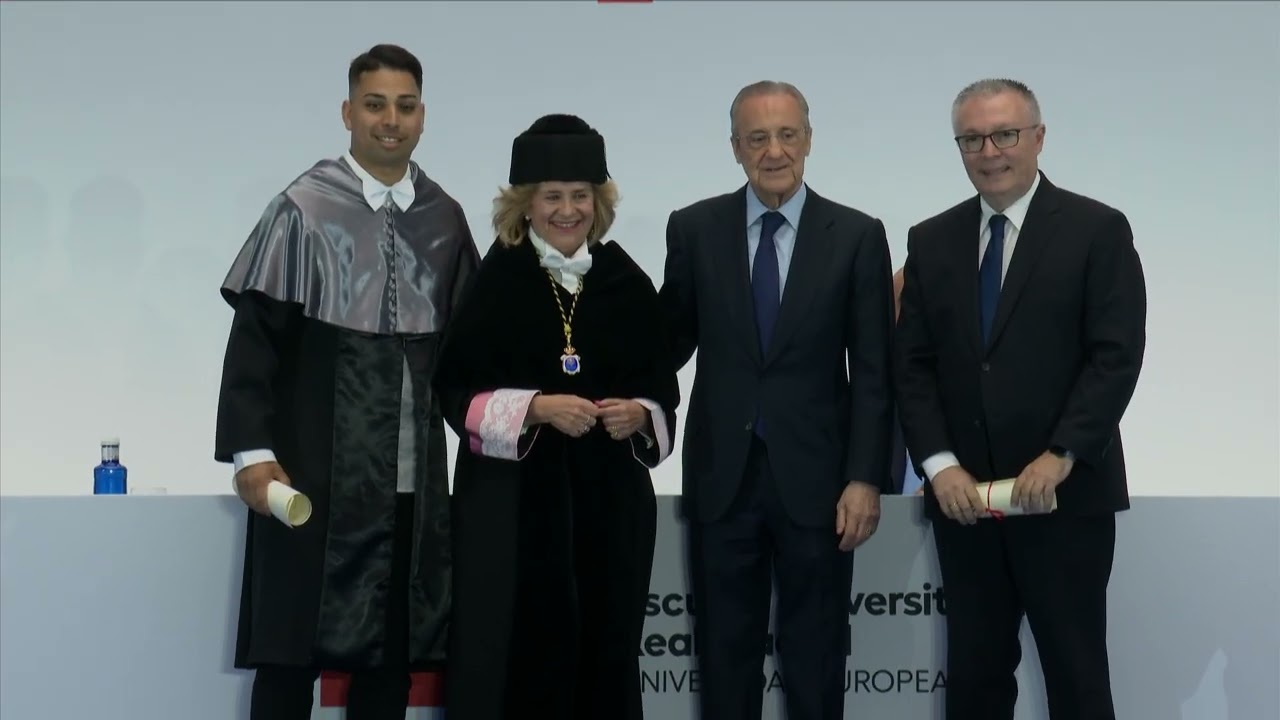
From the classroom to success: their stories
Ismael Parrilla
CEO | NSCA Spain
When you decide to do a master’s degree of this prestige and you decide to invest a lot of time, you want to choose the best one. By choosing this programme I was able to meet many people from different countries with important roles in their companies. The syllabus is in line with the professional demands of the market and the professionals behind it. The positioning of this master’s degree and the international positioning is what helped me decide to choose the Escuela Universitaria Real Madrid Universidad Europea.

Steve Cote
Global Affairs Canada
This master’s offered me everything I was looking for. It allowed me to study from anywhere I wanted and work at the same time. I enjoyed the networking opportunities and sharing this experience with people from all over the world.

Emile J. Machado
CEO | Profit4life
All the information I get for the MBA, I feel I have all the tools that I need to the development my self as a professional even the networking I get in this MBA is amazing.

Horizon breakers: pushing boundaries, creating your future with AI
At Escuela Universitaria Real Madrid Universidad Europea, we’ll teach you how to apply artificial intelligence (AI) in real-world settings. We’re proud to be recognised by Forbes as one of the most influential universities in education for 2025, thanks to our strong commitment to generative AI.

You’ll have access to the Advanced Course in Study Techniques with AI, where you’ll learn step by step how to integrate artificial intelligence into your daily life as a student.
You’ll use tools to increase your productivity and optimise your learning process, enhancing your academic experience and improving your results.
You’ll also take part in an exclusive workshop with Google, where industry professionals will guide you through the implementation and use of various AI applications.
Throughout the master’s programme, you’ll have the opportunity to participate in the AISports initiative, attending workshops and learning from experts how to implement AI in sports management.
Discover how AI is transforming the sports sector through real-world case studies, showcase your abilities, and earn your AISports digital badge.
Study plan
The curriculum is composed of ten modules that will provide you with practical, multidisciplinary and up-to-date training. At the end of the programme, the student will receive the Private Master's Degree Executive MBA in Sports Management - online, granted by Universidad Europea de Madrid.
Study plan structure
Module 1. General management (6 ECTS)
Gain an overview of the global sports industry and an introduction to strategic planning.
- Global financial vision.
- Tools used for a company's strategic planning and analysis.
- Business planning.
6 ECTS. 1st trimester.
Module 2. Finance (6 ECTS)
Learn the basic financial concepts and how to apply them to the sports sector, with their distinguishing characteristics.
- Introduction to finance and accounting.
- Profit and loss account.
- Balance.
- Cash flow.
- Budget and control.
- Economic analysis.
- Investment analysis.
6 ECTS. 1st trimester.
Module 3. Marketing and communication (6 ECTS)
Learn the basic marketing knowledge and its impact on the overall strategy of the company. Analyse new trends and different practices in the international sports market.
- Segmentation and positioning.
- Market research.
- Marketing plans.
- Operational marketing, with an emphasis on sports sponsorship.
6 ECTS. 1st trimester.
Module 4. Management and operation of sports venues (6 ECTS)
Learn how to best manage the sports facilities that require special knowledge and skills due to their practices or construction.
- Daily use facilities, stadiums and sporting events.
- You will acquire the necessary skills to achieve effective management.
- You will analyse aspects related to the location and distribution of space, access, security, technology, etc.
6 ECTS. 2nd trimester.
Module 5. Management skills (6 ECTS)
Learn essential leadership skills for effective employee management, so that organisations can fulfil their obligations to all stakeholders.
- Basic principles of HR, such as identifying, selecting and retaining talent, as well as team management.
- Sports coaching, application of emotional intelligence in organisations and applying sport values to the business ecosystem.
6 ECTS. 2nd trimester.
Module 6. Specialization branch - Sustainability and sports for development (6 ECTS)
Learn how to develop business projects based on social responsibility and sustainability criteria.
- Corporate social responsibility and transferring values through sport at an international level.
- International legal knowledge that makes global entrepreneurship possible.
6 ECTS. 2nd trimester.
Module 7. Specialization branch - Marketing & communication (6 ECTS)
Examine how the use of communication in the sports industry has changed and requires specialization.
- Commercial use of large data sources, especially at an international level.
- Impact and opportunities of new media and social media on sport.
6 ECTS. 3rd trimester.
Module 8. Specialization branch - Sport facility operation (6 ECTS)
You will work with sports or sports facilities that require specific knowledge and skills that go beyond the experience gained through the management of regular facilities.
- Identify and distinguish between a wide variety of sports facilities.
- Gain the necessary skills to reach an appropriate level of management.
6 ECTS. 3rd trimester.
Module 9. Master's thesis (6 ECTS)
You will have the opportunity to showcase all the knowledge gained during the course and apply it in a real business scenario with an overview of each discipline of sports management.
- You will work in groups of four people.
- You will have a designated professor who will accompany the group in the process.
- Presentation will be in-person or via videoconferencing.
6 ECTS. Cross-sectional trimester.
Module 10. Internships (6 ECTS) optional
This course must be selected or module 11.
- You will complement your specialised training with professional practices that match your interests and expectations.
- Format: In-person or remote.
- Recognition of internships: Having held sports management roles in an entity for at least one year.
6 ECTS. Cross-sectional trimester.
Module 11. Entrepreneurship & innovation in sports (6 ECTS) optional.
This course must be selected or module 10. This module is designed to guide students who consider entrepreneurship and the establishment of sports enterprises as a potential path for their professional development.
- Entrepreneurial initiative in the sports ecosystem.
- Innovative business opportunities and ideas in the sports industry.
- Monetization and revenue sources: new business models.
6 ECTS. Cross-sectional trimester.
Online exams and TFM
This master's degree is 100% online. You will be able to take the exams and the TFM virtually.
An intensive one-year programme to specialise in sports management
1
First semester – Fundamentals of sports management and a global industry perspective
In the first months, you will acquire a solid foundation in the sports industry, its management structures, legal and financial frameworks, and the global relevance of sports marketing and sponsorship.
- Analyse the structures of sports organisations, their institutional environment and international governance models.
- Master the fundamentals of financial management applied to sport, including budgeting and economic control.
- Explore the principles of sports marketing and sponsorship with a focus on digital trends.
2
Second semester – Strategy, innovation and international experiences
You will progress to strategic management and innovation, applying your knowledge to real projects. You will also take part in international experiences and complete your Master’s Final Project.
- Develop business strategies for clubs, leagues and global sports organisations.
- Apply tools for innovation, digitalisation and sustainability in sports management.
- Take part in international experiences and complete a professionally-oriented Master’s Final Project.
More information
Degree competencies
Core competencies
- CB1 - Students possess the required knowledge and understanding that provides a basis or springboard for originality in the development and/or application of ideas, often in a research context.
- CB2 - Students can apply the knowledge they have acquired and are able to solve problems in any new or unfamiliar situation which may arise within a broader or multidisciplinary context relating to their area of study.
- CB3 - When faced with the difficulty of making tough decisions, students can apply what they know, and, when information is limited, they must take into account and apply the social and ethical responsibilities associated to the situation.
- CB4 - Students can communicate their conclusions—and the knowledge and rationale behind them—to audiences who may be both specialised and non-specialised in the area. They must be able to do so in a clear and unambiguous manner.
- CB5 - Students develop the skills to allow them to continue studying in a self-led or autonomous manner. Students must possess the necessary learning skills that will enable them to continue to study in a self-directed, autonomous way.
Multidisciplinary competencies
- CT1 - Responsibility: Commitment to yourself and others when performing a task and trying to achieve a set of objectives within the learning process. Existing capacity in every subject to recognise and accept the consequences of a freely performed act.
- CT2 - Self-reliance: Students are able to act confidently and with sufficient motivation to achieve their objectives.
- CT3 - Awareness of ethical values: Ability to think and act according to universal principles based on human values aimed at assisting their full development in addition to their commitment to certain social values.
- CT4 - Communication Skills: Communication is the process by which we transmit and receive data, ideas, opinions and attitudes to transmit meaning, understanding and plans of action. Verbal communication is through words and gestures and, written communication through writing and/or visual support.
- CT5 - Interpersonal relationship skills: Students are able to perform active listening skills in order to reach agreements using an assertive communication style.
- CT6 - Flexibility: Students are able to adapt and work in different and varied situations, and in tandem with diverse groups. It involves assessing and understanding different ideas and adapting their own approach as the situation requires.
- CT7 - Teamwork: Ability to integrate and actively collaborate with other people, areas and/or organisations to achieve common objectives.
- CT8 - Initiative: Ability to anticipate problems, propose improvements and persevere in achieving them.
- CT9 - Planning: The process of setting goals and choosing the means to achieve those goals using time and resources effectively.
- CT10 - Innovation and creativity: Ability to propose and develop new and original solutions that add value to problems posed, even in areas other than the problem itself.
Specific competencies
- CE.1. - Have an integrated vision of all the dimensions of the company in the sports sector—external, internal or organisational—and that of the people or human capital that form them. Ability to analyse the problems and find solutions that allow you to achieve your strategic objectives. Students will assume an autonomous and collective learning style that allows them to make decisions and assess the economic and social impact of the decisions made.
- CE.2. - Lead projects and teams with an approach that integrates ethical and social responsibility, while assessing the impact of decisions on associations, the market, people and society.
- CE.3. - Master the keys to the major areas of world sport, in order to turn them into competitive advantages for the growth of the company within its sector.
- CE.4. - Analyse the economic, legal and technological environment of a sector and carry out an evaluation and a medium and long term strategic plan using the existing reference tools.
- CE.5. - Master the new trends and business practices of corporate social responsibility policies that affect the sports sector, and be able to define a corporate social responsibility policy for each company.
- CE.6. - Assume the skills and competences of a manager: leadership, emotional intelligence, communication, team management, group work, planning, conflict resolution, negotiation and orientation to results. Use them from a responsible approach and under a multicultural perspective, always respecting diversity.
- CE.7. - Master the concepts and strategic reference tools for the organisational dimensioning of a company in the sports industry and be able to select the best strategic alternative to apply in each market and company.
- CE.8. - Know the management tools for the operations of a company, as well as the business practices of reference in the sports industry, which ensure the efficiency of the activity and the fulfillment of the objectives set.
- CE.9. - Design the plans of different areas—marketing, communication and sales, finance, production, human resources—using the coordination criteria between them and aligning them to the company's general strategy.
- CE.10. - Master the key concepts of reference for the development of new organisational structures and be able to execute plans that involve changes and adaptations with criteria of resource optimisation and knowledge management.
- CE.11. - Apply and execute everything they have learned in one of the company’s decision-making areas through professional internships. They can do so through the University’s agreements with companies in the sports sector or industry, and especially in the area of interest most appealing to their future professional development—management, marketing and communication, operations or finance—and showcase their skills in order to integrate successfully into a business team.

Methodology
Flexibility: our online methodology allows you to adapt your studies to your needs.
Support: you will have the support of our expert professors who will facilitate your learning, as well as an accompanying tutor who will guide you and help you achieve your goals.
Experiential learning: learn by doing, without action there is no learning. Receive comprehensive training based on real-life cases combined with theoretical and practical learning.
Constant communication: with the latest technologies, you will be in direct contact with the university, your professors and your classmates.

Our educational model

Experiential learning

Meaningful learning

Collaborative learning

Professional learning

Constructive and discovery learning

Autonomous learning

Individualised learning

Creative learning
Admissions
Recommended profile
The Executive MBA in Sports Management online is designed for:
- Professionals who wish to change sectors and want to focus their professional career on the management of entities in the sports industry.
- Professionals who already work in the sports industry and wish to gain new knowledge and update their training.
- Current or former athletes who want to develop their business skills.
Admissions requirements
For access to the Accredited Private Master`s Degree Executive MBA in Sports Management online it is necessary to fulfill one of the following requirements:
- To be in possession of a university degree. In the case of being a graduate from a university outside of Spain, it is not necessary to have had the degree officially recognised by the Spanish Education Ministry.
- To have accredited professional experience related to the programme of interest. This guarantees the achievement of the abilities specified in the profile for prospective students section. Some of the programmes offered at Universidad Europea do not allow access through professional experience. See the full list here.
- Higher vocational training graduates who can accredit professional experience after completion of the internship.
In all cases, the University may limit access to certain degrees if a specific university degree has not been previously completed.
Demonstrate having the right level of English according to the chosen course, which will be evaluated through a personal interview.
Admissions process
The admission process to pursue an online undergraduate or postgraduate certificate at Universidad Europea can be carried out throughout the year, although enrolment on any of our programmes is subject to availability. In order to complete the process, follow these simple steps:
1
Documentation
You will need to send the specific documentation to your personal advisor
- Admissions form.
- Legal document required for accessing the programme
- Photocopy of your ID.
- Curriculum vitae.
2
Admissions test
Once your documentation has been reviewed, your personal advisor will contact you.
- Competency assessment test.
- Personal interview.
- Language assessment test (B2).
3
Reserving a place
Formalising the reservation of a place through our different methods of payment
- Direct debit.
- Credit card.
- Online payment.
Scholarships and financial aid
We want to help you. If you want to study at Universidad Europea, you will have at your disposal a wide selection of own and official scholarships.
Credit recognition and transfers
You don’t have to stick with something you don’t like. That’s why we’ve designed specific plans for credit recognition and transfers.
Request your online credit recognition review, transfer your academic file and start studying at Universidad Europea.
Faculty

Programme director: Dr. Pablo Burillo
PhD in physical activity and sports sciences from Universidad de Castilla-La Mancha, with a master’s in sports organization management and accreditation as a tenured lecturer by ANECA.
Meet the faculty


You have seen of 17 results
Frequently asked questions
What should I do after a degree in sport science?
A degree in sport science will give you a good grounding to either launch a professional career in the business side of the sport sector or go onto further studies. If you choose the later, the online Master in Sports Management provides all the necessary knowledge about the management of entities in the sports industry.
How do I become a sports manager?
To develop professionally managing and leading sports institutions such as clubs, fitness centers, federations, sports schools in specialised management areas within the sports industry, you must have a multidisciplinary profile tailored towards the sports sector, and with knowledge of marketing, communication or organising sporting events. To do this, studying an MBA specialised in sports management will provide you with this profile.
Where can I do my internship?
You will be able to complete your internship throughout the academic year with leading entities in the sports sector, of which one is Real Madrid C.F.
What specialities does the MBA in Sport Management online offer?
The MBA in Sports Management online has specialties in artificial intelligence, big data, digital transformation or sports coaching.