
- The final list of nominees recognises university and vocational education teachers put forward by their own students, in awards that celebrate teaching excellence, educational innovation and the impact teachers have on students
Teaching excellence can be seen in what students learn, but also in the confidence they gain, how they begin to see themselves as professionals and their ability to connect learning with life beyond the classroom. That approach has earned seven Universidad Europea teachers a place on the final list of nominees for the 2026 EDUCA ABANCA Best Teacher in Spain Awards.
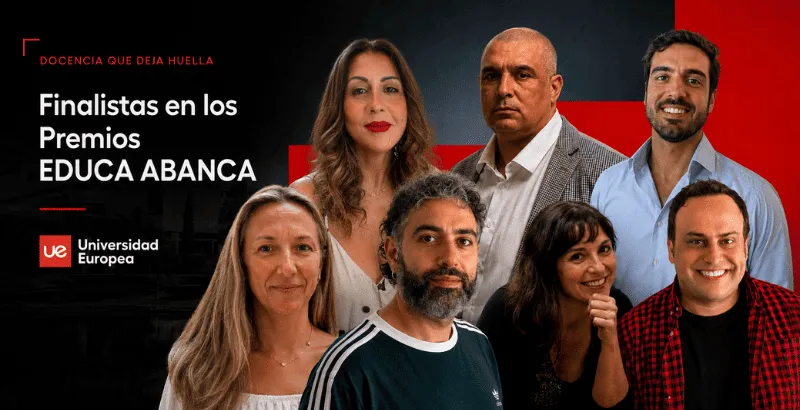
Ghada Aboud, Fernando Boillos García, Javier González del Castillo, Jorge López Fernández, Alejandro Majali Martínez and Ángela Ruiz Plaza have been nominated in the University category, while Pilar López Simón has been nominated in the Vocational Education category. The awards carry particular meaning because teachers cannot put themselves forward: they are nominated by their students or, in the case of Early Childhood and Primary Education, by students’ families.
EDUCA ABANCA received more than 1,500 nominations from across Spain for this year’s awards. After reviewing the information submitted by those making the nominations, the organisers published the final list of nominees. The next step is to select ten finalists in each category.
Teaching built on a connection with students
For the nominated teachers, the fact that the recognition comes from their students makes it especially meaningful. Javier González del Castillo, director of Universidad Europea’s Master’s in Artificial Intelligence Applied to Sport, has received his latest nomination with “enormous gratitude” and is moved to know that it came from his students. “The fact that students themselves submit the nominations makes this recognition very special, because it comes from the people with whom we share our daily work in the classroom,” he says.
Pilar López Simón, a teacher on the Advanced Vocational Training Programme in Marketing and Advertising at the Centro de Formación Profesional Europeo de Madrid, likewise emphasises that the recognition comes from those who have experienced her classes firsthand. “The simple fact that they wanted to nominate me is, in itself, the greatest award I could receive,” she says. For her, the nomination is meaningful because former students chose to recognise the way she supported their learning.
Alejandro Majali Martínez, a Medicine lecturer at Universidad Europea, sees teaching as demanding and deeply rewarding. He stresses the importance of creating a safe classroom environment where asking questions, expressing doubts and reflecting are natural parts of learning. “This award feels like the hug you give your students at the end of the academic year when you wish them all the best. This time, they are the ones giving me that hug,” he explains.
Ángela Ruiz Plaza, an Architecture lecturer at Universidad Europea, also highlights the emotional significance of recognition that comes directly from students. For her, teaching means offering support, sparking curiosity and helping each student discover their potential. “What moves me most is not that they remember a subject, but that they remember someone who believed in them, listened to them, supported them through moments of uncertainty and helped them grow,” she says.
Learning by doing to prepare for professional life
Connecting university learning with professional practice is a common theme in the nominees’ accounts. Fernando Boillos García, a lecturer on Universidad Europea’s University Master’s in Educational Innovation, believes practical learning is one of the main strengths of the university’s academic model. “Through projects, challenges, simulations and situations close to professional reality, students stop being passive recipients of information and take an active role in their education,” he says.
Jorge López Fernández, director of the Online University Master’s in Sports Marketing at the Real Madrid–Universidad Europea Graduate School, applies the same idea to the sports business sector. In his classes, assignments take the form of real professional briefs, with broad objectives, constraints and a specific professional role for each student. “I try to make the classroom work a little like a space for professional training, while keeping its university context,” he explains. This approach requires students to research, diagnose problems, analyse data, justify decisions and defend proposals from a strategic perspective.
For González del Castillo, practical learning allows students to start acting like professionals while they are still in the classroom. Analysing real cases, designing projects, solving problems, presenting proposals and using professional tools help them build confidence before entering the workplace. “That process gives them more complete preparation and, above all, confidence grounded in real learning experiences,” he adds.
Ghada Aboud, coordinator of Universidad Europea’s Bachelor’s Degree in Early Childhood Education, applies this approach to the education of future teachers. In her classes, theory is connected to real situations, case studies, simulations, practical resources and inclusive proposals. “My goal is not for my students to be able to explain how to teach; my goal is for them to leave university already feeling like teachers,” she says. For Aboud, learning to teach involves practice, reflection, making mistakes, supporting others and growing together.
High standards, personal support and critical thinking
Alongside practical learning, the teachers share a belief that preparing professionals also means developing the human, ethical and critical dimensions of each discipline. For Ghada Aboud, this is her fifth consecutive nomination and reflects a 26-year career devoted to education. She believes a teacher’s lasting impact comes from what students learn and from how supported they feel along the way. “I believe a teacher leaves a mark when students feel they have learned, but above all when they feel they have been seen, heard and supported,” she says.
Ángela Ruiz Plaza expresses a similar view from the perspective of architecture. For her, high academic standards should go hand in hand with personal support and feedback that helps students grow. “Caring for students is not at odds with demanding a lot of them. Quite the opposite. I think we can only truly challenge students when they feel that the person teaching them sincerely wants them to become the best version of themselves,” she explains. From this perspective, architecture becomes a way to improve people’s lives, regenerate their surroundings and tackle real challenges through creativity, research, biomaterials, artificial intelligence and digital fabrication.
In Medicine, Alejandro Majali Martínez focuses on the personal and emotional connection formed in the classroom. His approach to teaching begins with understanding students’ needs and creating a space where learning can be engaging, collaborative and motivating. “Above all, it speaks to the mutual affection between teacher and students, and to teaching with understanding and empathy,” he says.
In Vocational Education, Pilar López Simón connects that same idea with the lasting impression teachers can make on the people they see every day in class. “I don’t think there is any greater satisfaction in teaching than knowing you have made a difference to the people you have supported in their learning,” she says. Her nomination reflects the value of teaching that is personal, practical and connected to students’ personal and professional growth.
Seven perspectives, one shared approach to university education
The seven nominees teach in different fields, spanning Education, Sport, Medicine, Architecture, Educational Innovation, Sports Marketing and Vocational Education. Their accounts nonetheless share a view of the classroom as a place to learn by doing, develop judgement, gain confidence, work on real problems and build a professional identity.
That approach reflects Universidad Europea’s academic model, which is based on experiential learning, educational innovation, connections with the professional world and support for students. For Boillos, this method gives students a safe environment in which to make decisions, solve problems, work in teams and learn from mistakes. For Jorge López, it puts students in charge of professional assignments that call for strategy, research and the use of performance indicators. For Aboud, it means preparing teachers who can support young children with sensitivity and responsibility.
The presence of seven Universidad Europea teachers on the final list of nominees for the 2026 EDUCA ABANCA Best Teacher in Spain Awards highlights the role of its teaching staff in shaping the university experience. Their teaching combines knowledge, practice, humanity, high standards and dedication. Its impact extends beyond the classroom, influencing how students see themselves, understand their chosen profession and prepare to contribute to society.