
How to make a social media plan: from goals to execution
April 30, 2026
A social media plan is a structured document that defines your goals, audience, content, channels and metrics. To build one effectively, you’ll need to set clear objectives, identify your target audience, choose the right platforms, create a content calendar, define your KPIs and measure results consistently.
For those looking to apply these skills professionally, the Degree in Marketing at Universidad Europea covers digital ecosystem strategy and e-commerce with hands-on training, including 400+ hours of real company internships.
If you’re already in the field, the Master’s Degree in Marketing Management builds expertise in agile methodologies, brand strategy and campaign execution, while the Online Master in Digital Marketing goes deeper into SEO, SEM, analytics and AI-driven campaign optimisation.
What is a social media plan?
A social media plan is a roadmap that organises your brand’s presence across platforms to achieve specific business goals. It connects day-to-day content decisions with broader objectives like lead generation, brand awareness and customer retention.
Unlike an improvised posting schedule, a structured social media plan defines what you publish, where and why, with clear audience segments, content formats, channel selection based on user behaviour and KPIs like engagement rate or conversion rate to measure what's working.
Without this foundation, social media becomes a series of one-off posts with no clear thread connecting them to business outcomes.
Why does social media planning matter in modern marketing?
A social media plan gives structure to something that can easily become scattered. Instead of posting reactively, you work from a defined content strategy with set objectives, assigned formats and scheduled publishing, which directly improves output quality.
Consistency is one of the most measurable benefits. Brands that post regularly build stronger audience recognition, higher engagement rates and more reliable data to optimise from. That data is only useful if your content is anchored to real business outcomes.
That’s where planning earns its place. Whether the goal is lead generation, community growth or product awareness, a structured plan connects each piece of content to a KPI and to your broader strategic marketing efforts. Social media works best when it moves in sync with search, email and paid media as part of a connected online marketing strategy.
How to make a social media plan: a step-by-step guide
To build an effective social media plan, follow a structured process that connects objectives, audience insights and measurable actions.
Define clear goals
Start by setting specific, measurable objectives. Avoid vague targets like “grow followers” and focus on outcomes instead:
- Increase website traffic by 20%
- Generate 100 qualified leads per month
- Improve engagement rate to 5%
Your goals shape which platforms you use, what you post and how you measure success.
Identify your target audience
A social media plan is only as strong as its audience insight. Go beyond basic demographics and analyse:
- Behaviour: which platforms they use and when
- Content preferences: formats, topics and tone they respond to
- Pain points: what problems they need solved
CRM data, analytics platforms and past campaign results are your most reliable sources here.
Choose the right platforms
Not every platform deserves your attention. Choose based on where your audience is most active:
- LinkedIn for B2B, thought leadership and professional audiences
- Instagram for visual brand storytelling and product-led content
- TikTok for high-reach, short-form video with younger demographics
Concentrating on two or three channels well beats spreading thinly across five.
Develop your content strategy
This is where your plan takes shape. Define:
- Content pillars: the core themes your brand owns (education, inspiration, promotion)
- Formats: video, carousels, stories, long-form posts
- Tone of voice: consistent across every platform, adapted to each one’s style
Each piece of content should connect back to a specific goal.
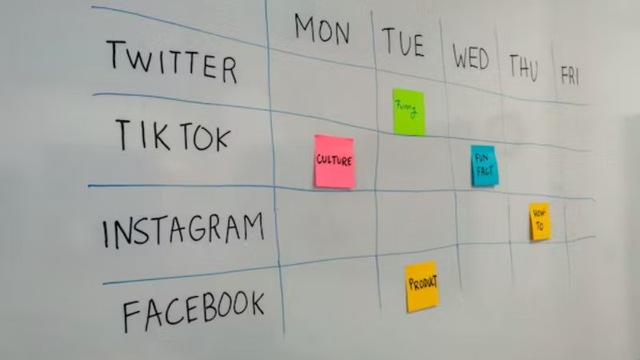
Create a content calendar
A content calendar turns strategy into execution. For each piece of content, log:
- Publication date and platform
- Format and content type
- Responsible team member or creator
It keeps your team aligned and makes it easier to plan around product launches, campaigns and seasonal events.
Define KPIs and metrics
Choose KPIs that directly reflect your objectives, not just the metrics that are easy to track:
- Engagement rate for community-building goals
- Conversion and click-through rate (CTR) for traffic or lead generation
- Reach and impressions for brand awareness campaigns
Vanity metrics like total followers tell you very little without context.
Monitor and optimise performance
Review performance on a fixed schedule: weekly for paid content, monthly for organic. Look at:
- Which formats drive the most engagement
- Which posting times generate the best reach
- Which platforms are delivering against your KPIs
Adjust based on data, not instinct.
Careers in social media and digital marketing
Social media planning skills open doors to a range of marketing roles. Social media managers lead strategy and content execution, while digital marketing specialists operate across multiple channels, managing campaigns that combine paid, organic and social activity.
Content strategists focus on the messaging frameworks that give those campaigns coherence, and community managers handle the day-to-day audience relationships that make a brand feel human.
What these roles share is a need for analytical thinking and creative judgment, as well as the ability to read data and act on it.
Knowing how to build a social media plan is one thing, but applying it under real conditions is where the learning sticks. At Universidad Europea, marketing programmes are built around campaign simulations, live brand briefs and data analysis projects that mirror what the industry actually demands.
Students gain hands-on experience with tools such as CRM platforms, Google Analytics and marketing automation software, alongside training in SEO, SEM and AI-driven campaign optimisation.
What sets the programmes apart is the balance between strategy and execution. Whether you're interning at real companies, mastering agile methodologies or learning to connect creativity with data to drive measurable results, the focus is always on building skills that transfer directly to the workplace.
FAQs
Do you need a separate plan for each social media platform?
Not necessarily. A single plan can cover multiple platforms, but it should include platform-specific content adaptations. What works on LinkedIn rarely works on TikTok, even if the underlying goal is the same.
What tools are used for social media planning?
The most widely used tools include Hootsuite and Buffer for scheduling, Meta Business Suite for paid and organic management, Google Analytics for traffic tracking and Notion or Trello for content calendar organisation.
How often should a social media plan be updated?
A social plan should be reviewed monthly and updated quarterly. Regular updates ensure that content, platforms and strategies remain aligned with performance data and business goals.
Can a social media plan work without a paid media budget?
Yes. Organic social media planning can deliver strong results, particularly for community building and brand awareness. Paid media accelerates reach, but a well-structured organic plan is a solid foundation on its own.