
- Coordinated by Álvaro Bustamante, the initiative brings together students from four European universities and 15 nationalities to design a mobile app for assessing performance and health in sport
Sport, engineering and artificial intelligence now share the same professional landscape. Data, technology and the ability to work across disciplines are transforming how athletes train, how performance is measured and how their health is supported. With this in mind, Universidad Europea launched the international project “Design of a mobile application wireframe for performance and health assessment in sport”. Based on challenge-based learning, the teaching innovation initiative brought together students from universities across Europe to design a mobile app for use in sport.
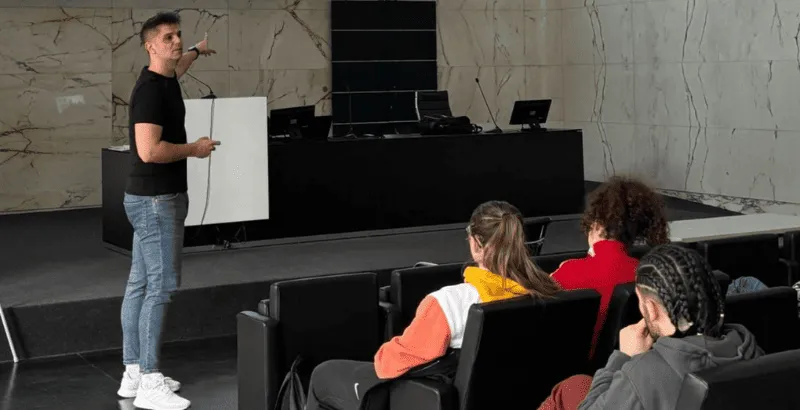
The project is coordinated by Álvaro Bustamante Sánchez, lecturer and researcher at the Faculty of Medicine, Health and Sport at Universidad Europea de Madrid and principal investigator of the Research Group in Applied Technology and Artificial Intelligence. As he explains, the idea grew out of his own academic and professional experience: “This project grew out of experiences and lessons that shaped me both personally and professionally, and a desire to give students access to the opportunities that helped me.”
A graduate and PhD in Sport Sciences who also holds a degree in Computer Engineering specialising in artificial intelligence, Bustamante has developed a project that brings together different disciplines, countries and approaches to learning. It began as a collaboration between Sport Sciences and Engineering students at Universidad Europea, before growing into an international project involving four universities where he has taught: Universidad Europea de Madrid in Spain; the University of Trás-os-Montes and Alto Douro in Vila Real, Portugal; Lithuanian Sports University in Kaunas, Lithuania; and the University of Rome Foro Italico in Rome, Italy. Students from Otto von Guericke University in Magdeburg, Germany, also took part, bringing the total to 15 nationalities. “Although academic careers tend towards specialisation, today’s professional world is increasingly global, fast-changing and interconnected,” Bustamante says.
The project ran online for ten weeks and was organised around five challenge-based milestones. Each team, made up of Engineering and Sport Sciences students, worked together to design a prototype mobile app. A distinctive feature of the approach was the freedom given to students to choose the variables, technologies, sensors and methods they would use. For Bustamante, that freedom had a clear purpose: “The lack of a fixed script is intentional: it is designed to encourage creativity, decision-making and independence.”
The experience allowed students to turn theoretical knowledge into practical solutions. Sport Sciences students contributed their understanding of performance, training load, recovery and health, while Engineering students brought design skills, computational thinking and technical expertise. Working together required each group to explain its knowledge in terms the others could understand. As Bustamante puts it, “It is not just about contributing knowledge, but about knowing how to explain it, adapt it and integrate it with knowledge from other fields.”
Artificial intelligence was part of the process, with an emphasis on responsible use. Students could use generative AI tools to help organise ideas or make progress on the challenges, but they had to document how they used them, explain their purpose and indicate how much they contributed to the final result. “AI should not think for us. It should help us develop critical thinking, professional judgement and the ability to make decisions,” says the project coordinator.
Alongside technical learning, the initiative strengthened skills valued in professional settings, including intercultural communication, coordination within international teams, management of complex projects and decision-making. Students highlighted how closely the experience resembled working in a professional environment. For Bustamante, that is what sets it apart: “The students are not simulating an international environment; they are actually experiencing one.”
Feedback on the experience was particularly positive. Participants gave an average agreement score of more than nine out of ten when asked whether they would recommend their university to other students if it included projects like this among its activities. For Bustamante, the result points towards a possible direction for higher education: “Students are showing us that these kinds of opportunities have a positive impact and could offer a way forward in addressing the education system’s current challenges.”
The project reflects Universidad Europea’s academic model, which is built on experiential learning, internationalisation, teaching innovation and engagement with real challenges in the professional world. It is an approach in which students learn by doing, collaborate with people from different fields and apply technology with a critical mindset. As Bustamante concludes, “Teaching innovations like this represent a more open, connected approach to higher education that is better suited to today’s major challenges.”