
What is hydrotherapy and what are its benefits in sports?
Sept. 15, 2026
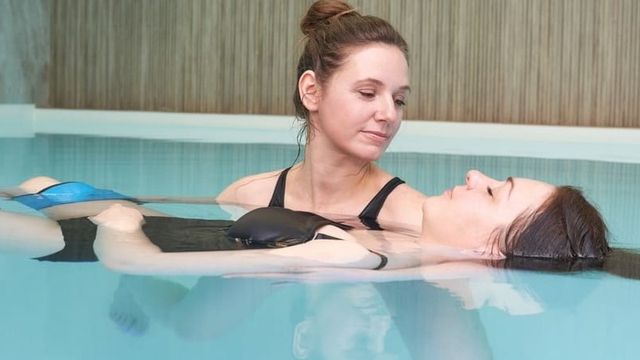
Hydrotherapy is the use of water, its temperature, pressure and resistance, to support physical recovery, rehabilitation and functional exercise. Instead of working against gravity on a mat or in a gym, you're working with water, and that changes what your body can safely do.
For an athlete, this matters most in the early stages after an injury. Say a footballer has just had ankle surgery. Walking normally on land might still be painful or unsafe, but in a pool, buoyancy takes a large share of their body weight off the joint, so they can start practising a normal walking pattern weeks before they'd be able to on dry land. That head start on movement quality often shapes how well the rest of the rehabilitation goes.
Water resistance works the opposite way. Every push or kick meets natural resistance from the water itself, so a physiotherapist can build strength and control without adding weights or machines, just by adjusting how fast or how deep the athlete moves.
A physiotherapist treating an athlete will typically adjust water depth, movement speed, resistance and temperature at each stage of recovery, tailoring the session to what that person's body can handle that week. These are the clinical decisions covered in depth in the Master in Sports Physiotherapy and in Online Master in Sports Physiotherapy, where hydrotherapy sits alongside manual therapy and neuroscience-based pain management.
What are the main properties of water used in hydrotherapy?
Buoyancy
Buoyancy takes weight off the joints. The deeper an athlete stands in water, the less of their own body weight they have to support, which makes movements like walking, squatting or stepping easier than they'd be on land.
An athlete recovering from lower-limb surgery can practise a controlled walking pattern in water weeks before their joint could handle the same movement on dry ground.
Hydrostatic pressure
Water presses against the body from every direction, and that pressure increases with depth. It also helps fluid move properly through the limbs and gives the body constant feedback on its position and movement, which is useful when rehabilitation focuses on balance or coordination.
Resistance
Water resists movement in every direction you push against it, and unlike a dumbbell, that resistance shifts with speed, surface area and direction. A physiotherapist can make a session harder simply by asking the athlete to move faster or by adding a paddle or fin to increase surface area.
Water temperature
Temperature decides what the water is being used for. Warm water eases pain and stiffness and makes movement more comfortable, which is why it's used for rehabilitation exercise. Cold water works differently and is typically used after training for recovery rather than as a form of therapeutic exercise itself.
What are the benefits of hydrotherapy?
Hydrotherapy reduces pain and makes movement possible in cases where land-based exercise is too difficult or too painful to tolerate.
The benefits shift depending on the type of aquatic technique used and how the programme is built, which is why sports physiotherapists tailor their approach to each athlete.
The evidence is strongest for musculoskeletal conditions. Research on people with osteoarthritis has found that aquatic exercise improves pain, stiffness and physical function compared with doing no exercise at all.
In practice, this translates into:
- Less pain during movement, since buoyancy reduces the load on the affected joint
- Better joint mobility, particularly where stiffness limits range of motion on land
- Progressive strength gains, built through water resistance rather than external weights
- Improved balance and coordination, supported by the sensory feedback hydrostatic pressure provides
- Greater tolerance of weight-bearing exercise, useful for athletes not yet cleared for full loading
- A safer entry point for early-stage rehabilitation, before land-based work is possible
- Reduced muscle soreness after some forms of exercise
- Better physical function in several musculoskeletal conditions
Hydrotherapy works best as a way of adapting the training or rehabilitation environment to what the body can currently handle, not as a fix for every type of injury.
How is hydrotherapy used for sports recovery?
Hydrotherapy supports recovery after hard training, mainly through cold-water immersion, though how well it works depends on what you're recovering from.
Cold-water immersion is the most studied water-based recovery method in sport. It can reduce delayed-onset muscle soreness and improve how an athlete feels after intense exercise, but the evidence for it improving strength or performance is much weaker.
There's also a catch for athletes training for muscle growth. Some research links regular cold-water immersion straight after resistance training to a stunted muscle-building response, so it shouldn't be used automatically after every session, it needs to match what the athlete is training for.
That's why physiotherapists weigh up training load, competition schedule, injury status and performance goals before recommending any water-based approach to sports physiotherapy.
How is hydrotherapy used in rehabilitation?
Hydrotherapy allows an athlete to move and rebuild strength in a controlled way while reducing the mechanical demand on the injured area.
A rehabilitation programme typically uses aquatic exercise to rebuild joint range of motion, muscle strength, balance, proprioception, walking mechanics, cardiovascular fitness and overall movement control. As the athlete progresses, the physiotherapist increases the challenge by adjusting depth, movement speed, resistance or exercise complexity, the same way you'd add load in a gym setting, just using water instead of weights.
This matters most after orthopaedic injuries, surgery and certain musculoskeletal conditions. Aquatic exercise has also shown benefits for pain and physical function in people with lower-limb osteoarthritis.
Hydrotherapy is usually one stage in a longer progression towards the movements someone needs for sport or daily life, and for anyone looking at how to become a sports physiotherapist, knowing how to build that progression is a core clinical skill.
Does hydrotherapy work?
Yes, but only when the technique matches the goal, as not every form of hydrotherapy does the same job. Using a pool because it's available isn't the same as prescribing a technique for a specific reason.
An athlete easing back into weight-bearing needs a different approach than one managing soreness between sessions, and the two shouldn't be treated as the same tool.
The real value of hydrotherapy is that it works when it's built into an individualised plan around the athlete's actual stage of recovery, not used as a routine add-on.
FAQs
Is hydrotherapy the same as swimming?
No. Hydrotherapy uses water for a specific rehabilitation purpose, with exercises chosen around an individual's needs. Swimming is a sport or general physical activity, not a clinical treatment.
How deep should the water be for hydrotherapy?
It depends on the goal. Deeper water increases buoyancy and takes more weight off the joints, while shallower water increases the load on the legs. A physiotherapist chooses depth based on what stage of recovery the athlete is at.
Can hydrotherapy replace physiotherapy?
No. Hydrotherapy is an exercise environment used within physiotherapy, not a substitute for it. Clinical assessment and rehabilitation planning still come from a qualified physiotherapist.
Is hydrotherapy suitable for every sports injury?
No. It depends on the injury, the stage of healing and any medical considerations involved. A qualified healthcare professional should confirm whether aquatic treatment is appropriate before it's used.