
Structure and Function Laboratories - Universidad Europea Andalucía
Located on Floor -1, with a surface area of 107.15 m² each, these laboratories are multidisciplinary spaces designed to meet needs in the health sciences area.
This space supports the integration of knowledge through workstations equipped with state-of-the-art resources for teaching histology and anatomy integrated with human physiology, enabling a complete view of the human body from complementary perspectives.
This facility enables students to learn about and understand the function of the different organs and systems of the human body from a microscopic to a macroscopic perspective, and promotes the start of clinical exploration through peer work to acquire technical skills for basic manoeuvres and procedures.
The tables, chairs and treatment couches are mobile, allowing the characteristics of the space to be adjusted according to the activity being carried out and creating a collaborative and integrative environment, ideal for implementing active learning methodologies.
In response to digital transformation, this space is equipped with digital whiteboards, interactive monitors, camera systems and high-resolution sound reinforcement for extended classroom activities, allowing students to follow classes in person or remotely and synchronously, interacting with the lecturer and classmates in an immersive way.
Specifically, the equipment in this laboratory is as follows:
- IT equipment (computers, interactive televisions and tablets) equipped with digital anatomy and histology atlases, virtual dissection and radiology applications, and experimental simulators. These devices are enhanced by an integrated audio and video system for optimal viewing and interaction between users. Examples of the software include: Netter Atlas, Visible Body, Visible Body: A & P, Anat. Lab. Histology, Smart Histology, Case Files, Biochemistry, etc.
- A virtual reality area, equipped with devices on which the 3D Organon software is installed.
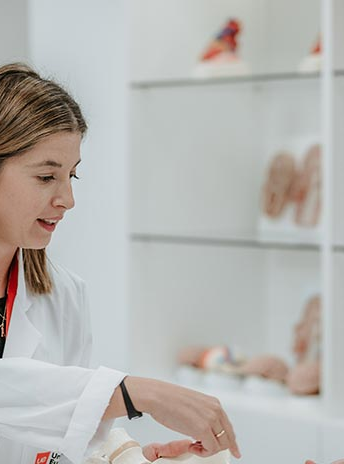
- An osteology collection and collection of anatomical models covering arthrology, splanchnology, the nervous system, myology and others, allowing their handling and interrelationship with other tools available for teaching.
- Computers equipped with physiological signal recording systems, with accessories including electrocardiogram, sphygmomanometer and other basic medical examination equipment for physiology practicals.
- A system for recording basic body parameters, with accessories including goniometers and electromyography equipment, and specialised software.
- Low-complexity simulators for basic clinical examination and training in procedures and skills such as basic life support techniques, suturing, sample taking, and various diagnostic and therapeutic procedures that complete the training and education of health professionals before they face clinical practice with real patients.
- Microscopes and histological samples for studying cell biology by recognising and differentiating different cell types, as well as different aspects of cellular physiology.